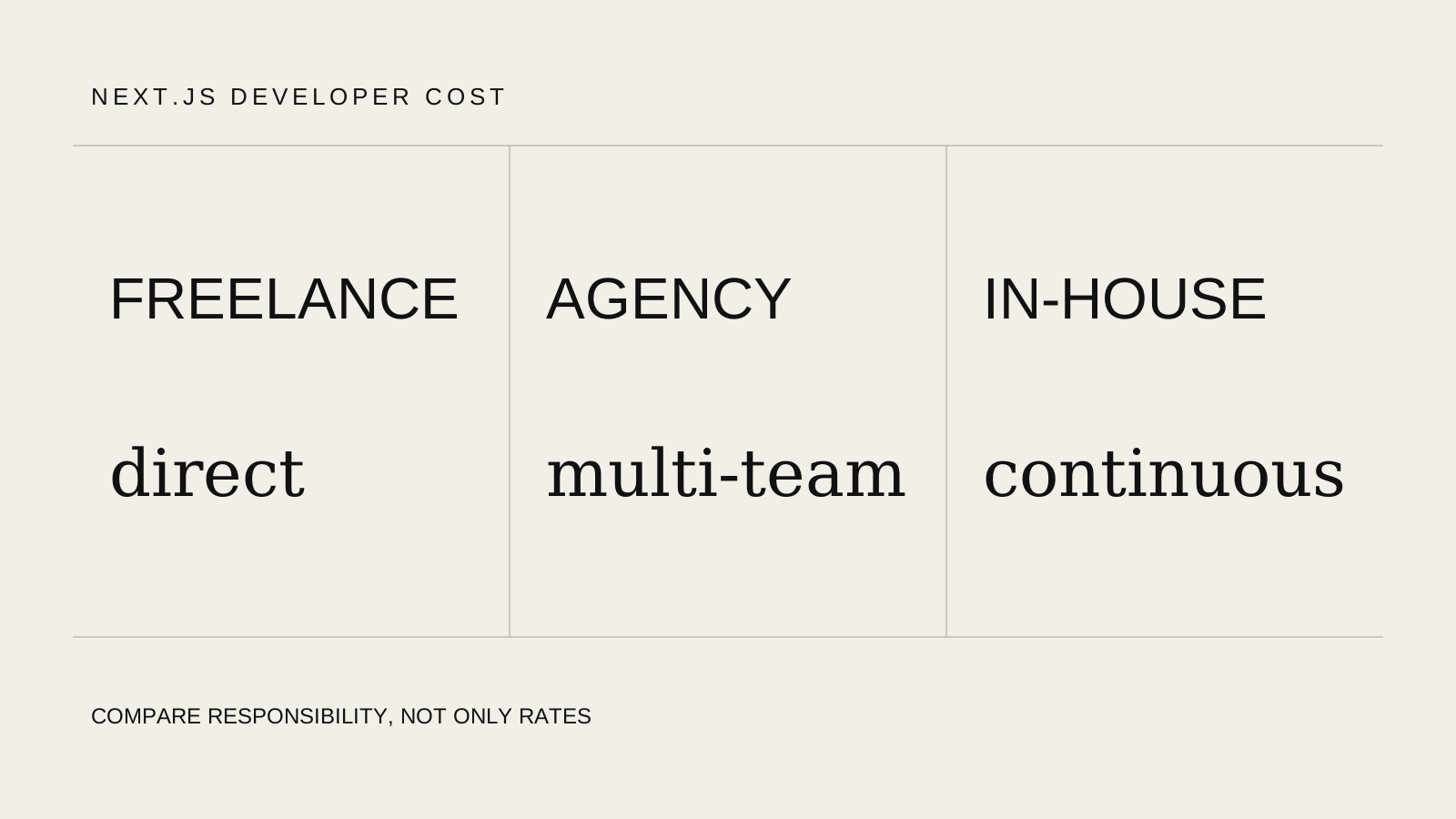
The cost of a Next.js developer depends less on the framework than on the responsibility attached to the role. Implementing approved pages against a documented CMS is different from defining architecture, migrating an indexed website and coordinating design, content and deployment.
Freelancers, agencies and employees package that responsibility differently. A fair comparison accounts for coordination, continuity and the work the client must still supply. Comparing hourly rates alone can make the least expensive proposal become the highest-effort option.
This guide does not provide a universal market price. Rates vary by location, seniority, availability and scope. It provides a method for comparing proposals without inventing certainty.
Build the cost model from scope
Before selecting a delivery model, divide the project into work areas:
- Discovery and requirements
- Content strategy and copy
- Visual and responsive design
- Component and page implementation
- CMS or API integration
- Migration and redirects
- Accessibility and testing
- Analytics and forms
- Deployment and launch
- Documentation and support
A developer hired for “the Next.js part” may cover only implementation. If no one owns content modelling or migration, those tasks do not disappear; they become delays or change requests.
The Next.js hiring page explains the information needed to qualify a project before an estimate is prepared.
What increases a Next.js project estimate
Page count is only one factor. A single account workflow can require more effort than several content pages because it includes authentication, validation, loading, failure and permission states.
Common scope drivers include:
- Original design rather than implementation from approved files
- Multiple reusable page templates
- Headless CMS modelling and preview
- Ecommerce or product APIs
- Authentication and personalised content
- Search and filtering
- Internationalisation
- Content migration
- Redirect mapping
- Complex animation
- Analytics event planning
- Accessibility evaluation
- Automated testing
- Infrastructure or deployment constraints
Uncertainty also affects cost. A documented API and realistic designs are easier to estimate than a concept with unknown integrations.
Freelance Next.js developer
A freelancer is often appropriate for a defined website, a frontend implementation or specialist support inside an agency or product team. Communication is direct because the person discussing the technical decision is usually the person implementing it.
What the client may gain
- Lower coordination overhead
- Direct access to technical judgement
- Flexible fixed-project or milestone engagement
- Ability to add specialist capacity without permanent hiring
- Clear ownership of a defined frontend scope
What the client must provide
A freelancer is not automatically an agency compressed into one person. The client may still need to own strategy, content, visual design or backend systems. Feedback delays have a larger effect when one specialist is waiting for decisions.
Ask whether the estimate includes design review, CMS configuration, content entry, redirects, analytics and post-launch support. The answer matters more than the label “freelancer.”
Next.js agency
An agency is useful when the project needs several disciplines under one delivery structure. It may provide strategy, design, copy, development, project management and quality assurance.
What the client may gain
- Broader range of disciplines
- Capacity for parallel work
- Formal project management
- Coverage when one team member is unavailable
- Established review and delivery processes
What changes the cost
The client pays for coordination and organisational capacity as well as production. That can be valuable when the scope genuinely needs it. It can be unnecessary when the designs, content and technical requirements are already owned by the client.
Ask who will actually implement the Next.js work, how senior review operates and how decisions reach the developer. A polished sales process does not confirm the experience of the delivery team.
In-house Next.js developer
An employee makes sense when the roadmap contains continuous frontend work and the developer needs deep product and organisational context. The investment includes salary, recruiting, onboarding, equipment, benefits and management—not only productive development hours.
What the business may gain
- Continuous product context
- Close collaboration with internal teams
- Ownership beyond a project deadline
- Faster response to ongoing product priorities
- Long-term stewardship of architecture
When it is inefficient
An internal hire may be difficult to justify for one redesign or a short migration. Recruiting can take longer than the project itself, and the organisation must provide a meaningful ongoing role after launch.
A contractor can bridge a defined delivery need, but should not be used to conceal a permanent, unmanaged workload.
Compare total responsibility, not rates
Create a comparison with the same rows for every option:
- Discovery included
- Design included
- Content responsibility
- CMS modelling
- Frontend implementation
- Backend or API responsibility
- Migration and redirect work
- Accessibility scope
- Testing environments
- Deployment ownership
- Documentation
- Warranty or support period
- Ongoing maintenance
- Client time required
One proposal may appear more expensive because it includes work another proposal leaves undefined. Ask every provider to list assumptions and exclusions.
Fixed price, day rate or ongoing retainer
A fixed price works when deliverables, review rounds and dependencies are reasonably clear. The provider carries more estimation risk, so unclear requirements usually produce a larger contingency or strict change control.
A day or hourly rate works for evolving scopes, audits and existing codebases where the effort cannot be known before investigation. It requires priority management and visible progress.
An ongoing retainer works when a steady stream of improvements exists. It is not useful when the client has no prepared backlog or cannot provide timely feedback.
The commercial model should match uncertainty. Forcing an exploratory migration into a fixed quote does not remove risk; it hides where the risk will surface.
The cost of migration and SEO preservation
Rebuilding an indexed website requires more than recreating its visible pages. Important URLs, metadata, internal links, structured content, forms and analytics must be reviewed.
Budget for:
- URL and content inventory
- Redirect mapping
- Metadata migration
- Canonical and sitemap verification
- Staging index controls
- Production crawl checks
- Analytics and form validation
- Monitoring after launch
No developer can guarantee that a redesign will improve rankings. They can reduce avoidable technical mistakes and make the migration process reviewable.
The cost of poor handover
A low-cost build becomes expensive when only one person knows how to run it. Confirm repository ownership, environment setup, deployment access, CMS documentation and third-party accounts.
The Gymerz Next.js case study documents the frontend technology and available interface scope without using private performance or revenue claims. That is the level of attribution you should expect when reviewing project evidence.
Questions to ask every provider
- What exactly is included in the estimate?
- Which inputs must the client provide?
- Which assumptions could change the cost?
- Who performs the work?
- How are scope changes approved?
- How is progress demonstrated?
- What testing is included?
- Who owns deployment and production verification?
- What documentation is delivered?
- What happens after launch?
Clear answers reduce the chance of comparing incompatible offers.
A practical selection rule
Choose a freelancer when the scope is defined, direct communication matters and the client can own adjacent disciplines. Choose an agency when multiple disciplines and parallel capacity are genuinely required. Choose an employee when the roadmap provides sustained work and organisational context is central.
The right option is the one whose responsibility matches the project, not the one with the lowest isolated rate.
Conclusion
Next.js developer cost is a consequence of scope, uncertainty, ownership and continuity. Prepare a useful brief, compare like-for-like responsibilities and ask providers to state what is not included. The website development cost guide provides a broader view of design, content, integrations and platform costs.
If a freelance specialist fits the project, review how to hire a Next.js developer or send the scope for a practical recommendation.
Frequently asked questions
Is a freelance Next.js developer always cheaper than an agency?
Not always. A freelancer may have lower coordination overhead, while an agency may include disciplines the client would otherwise source separately. Compare deliverables and client effort.
Can a Next.js project be quoted at a fixed price?
Yes, when requirements, design, content, integrations and review expectations are sufficiently clear. Discovery may be needed before fixing the full implementation price.
Why do two Next.js estimates differ significantly?
They may include different responsibilities, seniority, testing, migration work, support and risk assumptions. Ask for a structured breakdown rather than comparing totals alone.
Should maintenance be included in the initial cost?
Launch support should be defined in the proposal. Longer-term dependency updates, monitoring and feature work can be priced separately according to the site’s needs.